Frequently Asked Questions
Find answers to common questions about our programs, services, and how you can get involved with Phoenix Assistance Dogs.
Why Phoenix Assistance Dogs?
Who we are, and what makes our approach different.
Phoenix Assistance Dogs (PAD) was founded in 2009 on the belief that individuals with disabilities deserve greater independence, opportunity, and support. Founded and led by individuals with firsthand experience living with disability, PAD combines lived experience with evidence-based training to create programs that are compassionate, practical, and effective.
Named after the mythical phoenix, a symbol of resilience, hope, and new beginnings, our organization exists to empower people through highly trained assistance dogs, education, and community. As a volunteer-powered nonprofit, every lesson, volunteer, and donation helps expand access to quality assistance dog training while strengthening the bond between handlers and their dogs.
At Phoenix Assistance Dogs, we believe the strongest assistance dog teams are built through partnership. Rather than simply training dogs, we empower handlers with the knowledge, confidence, and support needed to train alongside their dogs using evidence-based, positive reinforcement methods.
Every team receives individualized coaching tailored to their goals, disability-related needs, and their dog's unique strengths. Membership includes far more than lessons—it provides ongoing mentorship, educational resources, progress evaluations, access to a supportive training community, and exclusive member benefits designed to help both handlers and dogs succeed.
As a volunteer-powered nonprofit, our mission extends beyond training exceptional dogs. We're committed to empowering individuals with disabilities, fostering lasting partnerships, and building a community where people and dogs can achieve greater independence together.
Getting Started
Programs, eligibility, cost, and how to take the first step.
Phoenix Assistance Dogs offers several programs designed to meet the unique needs of individuals, families, and organizations.
Our Owner Trainer Program is designed for individuals who want to train their own assistance dog with professional guidance and ongoing support. We also offer an In-Home Assistance Dog Program for handlers whose disabilities primarily require task work within the home, and a Companion Dog Program for families seeking a well-trained pet using the same evidence-based, positive reinforcement methods used throughout PAD.
In addition to our training programs, PAD offers a Volunteer Puppy Raising Program, assistance dog certification for PAD Partners, educational resources, and volunteer opportunities. If you're unsure which program best fits your needs, we're happy to help you determine the best path forward.
The right program depends on your goals, your disability-related needs, and whether you already have a dog.
If you have—or plan to acquire—a dog that you'd like to train as an assistance dog, our Owner Trainer Program is the best place to start. If your disability-related needs are primarily within your home, our In-Home Assistance Dog Program may be a better fit. Families who simply want an exceptionally well-trained companion can enroll in our Companion Dog Program.
If your goal is to help future assistance dog teams rather than train your own dog, consider becoming a Volunteer Puppy Raiser or exploring one of our many volunteer opportunities.
If you're not sure which option is right for you, we'd be happy to discuss your goals and help you find the best fit.
Getting started is easy!
Explore our programs and choose the one that best fits your goals. Then, complete the appropriate application on our website.
After we receive your application, a member of our team will review your information and contact you about the next steps. Depending on the program, this may include an interview, orientation, a dog evaluation, or guidance in selecting an appropriate assistance dog prospect.
Our goal is to ensure every team begins training with realistic expectations, individualized guidance, and the support needed for long-term success.
The Owner Trainer Program is open to individuals with disabilities who wish to train their own assistance dog with professional guidance and support.
Whether you're starting with a puppy, an adolescent, or an adult dog, we'll evaluate your individual goals, your dog's temperament, health, and aptitude to determine whether they're a good candidate for assistance dog work. While not every dog is suited for public access work, many dogs have the potential to become successful assistance dogs with the right training and partnership.
Maybe! Many successful assistance dogs begin as beloved family pets.
The most important factors are your dog's temperament, health, trainability, and willingness to work—not their age or where they came from. During an evaluation, we'll assess whether your dog has the qualities needed for assistance dog work and discuss realistic expectations based on your goals.
If your current dog isn't a good candidate, we're happy to help you understand why and provide guidance on selecting a future prospect.
No. While many teams begin with a puppy, dogs of many ages can successfully enter training.
Puppies offer the advantage of building strong foundations from the beginning, but adolescent and adult dogs may also become excellent assistance dogs if they possess the appropriate temperament, health, and aptitude. We'll help evaluate your dog's potential and recommend the best training path for your individual situation.
PAD works with individuals living with a wide variety of disabilities. Assistance dogs can be trained to perform tasks that mitigate physical, psychiatric, neurological, and certain medical disabilities, depending on the individual's needs and the dog's abilities.
Rather than focusing on a diagnosis alone, we focus on how an assistance dog may improve your independence, safety, and quality of life. Because every individual is unique, training is customized to meet each handler's specific goals.
PAD offers several membership options to meet the needs of different handlers and families.
Our Owner Trainer Membership is available both locally and virtually. We also offer In-Home Assistance Dog Membership and Companion Dog Membership, each designed to provide ongoing professional instruction and support.
Membership includes much more than training lessons. Depending on your program, benefits may include educational resources, trainer support between lessons, progress evaluations, access to our private training community, homework, discounts, and other exclusive member benefits.
Current pricing and membership details are available on our Programs page, or feel free to contact us with any questions.
PAD membership is designed to provide ongoing support throughout your training journey—not just scheduled lessons.
Depending on your program, membership may include private and/or group lessons, educational resources, weekly homework, progress evaluations, trainer support between lessons, access to our private training community, Board & Train opportunities, trusted pet sitter referrals, wholesale pricing on training equipment, and additional member benefits. Assistance dog memberships also include benefits such as free dog food (pickup required) and participating veterinary discounts.
Our goal is to provide the education, mentorship, and support needed to help both you and your dog succeed.
Yes! PAD proudly works with teams both locally and across the country through our Virtual Owner Trainer Program.
Virtual training includes individualized coaching through live video sessions, homework, progress tracking, educational resources, and ongoing trainer support. Many aspects of assistance dog training can be effectively taught remotely while allowing teams to practice skills in their own homes and communities.
No. While many of our members live in Pennsylvania, our Virtual Owner Trainer Program allows us to work with teams throughout the United States.
Some services and events are available only to local members, but virtual teams receive individualized coaching and support designed to help them achieve the same training goals from wherever they live.
Most new members can begin shortly after completing the application and onboarding process.
Your start date will depend on factors such as trainer availability, program enrollment, and whether you're beginning with your own dog or are still searching for the right prospect. We'll work with you to develop a timeline that best supports your success.
Training Philosophy
How we train, and why we train that way.
At Phoenix Assistance Dogs, we believe the best assistance dogs are confident, enthusiastic partners who genuinely enjoy their work. That's why we use evidence-based positive reinforcement training methods supported by decades of research in animal learning and behavior.
Rather than relying on fear, intimidation, or punishment, positive reinforcement focuses on rewarding behaviors we want to see repeated. This approach strengthens the bond between handler and dog, builds confidence, encourages problem-solving, and creates reliable behaviors that transfer into everyday life.
Because assistance dogs must work safely in a wide variety of environments, our goal is to develop dogs that make thoughtful, confident decisions—not dogs that simply respond out of fear of making a mistake.
No one knows your daily routines, challenges, and goals better than you do.
Owner training allows handlers to actively participate in every step of their dog's education while building an extraordinary bond through thousands of shared learning experiences. This partnership often results in excellent communication, a deep understanding of one another, and task work that is customized to the handler's unique needs.
With professional guidance, structured training, and ongoing support, owner-trained assistance dogs can achieve the same high standards of behavior and public access expected of any well-trained assistance dog.
At PAD, we don't simply teach dogs—we educate teams.
Our programs combine individualized coaching, evidence-based training, educational resources, homework, progress evaluations, and ongoing mentorship to help handlers understand both how and why their dogs learn. Rather than offering isolated lessons, we provide a comprehensive support system designed to guide teams from foundation skills through advanced assistance dog training.
As a volunteer-powered nonprofit founded and led by individuals with firsthand experience living with disability, we understand the unique challenges our members face. Our goal is to create confident, capable handler-dog partnerships while fostering a welcoming community where members continue learning long after their first lesson.
Owner Trainer Program
What training looks like week to week once you join.
PAD's Owner Trainer Program empowers individuals with disabilities to train their own assistance dogs with professional guidance every step of the way.
Rather than receiving a fully trained dog, members work alongside experienced trainers to teach public access skills, task work, obedience, and everyday life skills tailored to their individual needs. Through monthly membership, teams receive ongoing instruction, educational resources, and support designed to help them build a safe, reliable, and confident assistance dog partnership.
Training frequency depends on your membership and, more importantly, on your practice between lessons.
Most members participate in scheduled lessons each month while completing homework and practicing skills throughout the week. Assistance dog training is built through consistent daily practice, and our trainers provide guidance, exercises, and support to help you continue making progress between lessons.
Some of the most important training happens between your scheduled lessons.
Members receive homework, training goals, educational resources, and ongoing trainer support to help them practice new skills in their everyday environments. We recommend a minimum of 15 minutes each day of focused, one-on-one clicker training, separate from classes and outings. Progress is reviewed regularly, allowing your trainer to adjust your training plan as your team develops.
Our goal is to provide continuous support—not just instruction during scheduled lessons.
We understand that life happens.
If you need to miss a scheduled lesson, please contact us as soon as possible. We'll work with you to determine whether the lesson can be rescheduled based on trainer availability and our scheduling policies.
Even if you miss a lesson, your trainer remains available to help guide your homework and answer questions so your progress can continue.
In many cases, yes.
Whether training multiple dogs at the same time is appropriate depends on your experience, your dogs' individual needs, and your training goals. We'll discuss your situation and determine the best approach to ensure each dog receives the time and attention needed to succeed.
Absolutely.
While many assistance dogs begin training as puppies, adult dogs can also become successful assistance dogs if they possess the appropriate temperament, health, and willingness to work.
We'll evaluate your dog's strengths and discuss realistic expectations before recommending a training plan.
There isn't one "best" breed for assistance dog work.
While many large assistance dog organizations rely heavily on Labrador Retrievers because of their long-established breeding programs, Phoenix Assistance Dogs believes success is determined by the individual dog, not simply its breed.
Research has consistently shown that behavioral traits such as temperament, confidence, resilience, sociability, trainability, and environmental stability are much stronger predictors of working success than breed alone. Genetics certainly matter, but careful selection of the individual dog is far more important than choosing a particular breed.
At PAD, we commonly work with Golden Retrievers, Standard Poodles, and purpose-bred crosses, as these dogs often possess the intelligence, temperament, and versatility needed for many types of assistance work. However, we also recognize that many other breeds—and even mixed breeds—can become exceptional assistance dogs when they possess the right qualities.
Rather than asking, "What breed makes the best assistance dog?" we encourage people to ask, "What dog is the best match for my disability, lifestyle, and goals?" Our focus is always on making the right match between handler and dog, because that's what creates successful teams.
Not every dog is suited for assistance dog work, and that's okay.
Some dogs may be better suited as beloved companions, therapy dogs, or participants in other canine activities. If your dog is not an appropriate candidate for public access work, we'll explain why, discuss your options, and help you develop the best plan moving forward.
Our goal is always to support both the handler and the dog while making decisions that prioritize safety, welfare, and long-term success.
Assistance Dogs
Definitions, timelines, task work, and public etiquette.
Although these terms are often used interchangeably, they each serve a very different purpose.
An assistance dog (also known as a service dog under the Americans with Disabilities Act) is individually trained to perform specific tasks that directly mitigate a person's disability. Under the ADA, assistance dogs are generally permitted to accompany their handler in public places where pets are not allowed.
A therapy dog provides comfort and emotional support to others by visiting hospitals, schools, nursing homes, and other community settings with a volunteer handler. Therapy dogs do not have public access rights under the ADA.
An emotional support animal (ESA) provides comfort simply through its presence but is not individually trained to perform disability-related tasks. ESAs do not have public access rights under the ADA, although they may have certain housing protections under other laws.
Understanding these differences helps ensure each type of working dog is respected for its unique and valuable role.
The biggest difference is who does the training.
With a program-trained assistance dog, a professional organization raises and trains the dog before placing it with a person with a disability.
With an owner-trained assistance dog, the handler actively participates in training their own dog, often with guidance from an experienced trainer or organization like PAD.
Under the ADA, both owner-trained and program-trained assistance dogs have the same legal public access rights, provided the dog is individually trained to perform tasks that mitigate a person's disability and meets appropriate behavior standards.
Neither path is inherently "better." The best choice depends on each person's disability, lifestyle, goals, and available support.
Every dog learns at its own pace, so there is no one-size-fits-all timeline.
Most assistance dogs require 18 to 24 months of consistent training, socialization, and real-world experience before they're fully prepared for the responsibilities of public access work. However, factors such as the dog's age, temperament, previous training, and the complexity of the required tasks can all influence the timeline.
Our goal is not to train as quickly as possible, but to build a safe, confident, and reliable assistance dog that is prepared for a lifetime of partnership.
At Phoenix Assistance Dogs, our goal is not to graduate every dog—it's to graduate the right dogs.
Assistance dogs must possess exceptional temperament, health, confidence, resilience, and the ability to safely perform disability-related tasks in a wide variety of environments. While many dogs are capable of becoming wonderful companions or therapy dogs, not every dog is suited for the unique responsibilities of assistance dog work.
Throughout training, we continually evaluate each dog's physical health, behavior, temperament, and overall suitability. If we determine that assistance dog work is not in a dog's best interest, we'll discuss the reasons openly and help develop the best path forward.
We believe recognizing when a dog is not the right fit is just as important as celebrating those that are. Our responsibility is to the safety, welfare, and long-term success of both our handlers and our dogs—and we will never compromise those standards simply to increase graduation numbers.
A dog's worth is never determined by whether it becomes an assistance dog. Every dog deserves a role where it can thrive.
In PAD's Owner Trainer Program, you own your dog throughout the training process.
Your trainer provides education, coaching, and support, but all decisions regarding your dog's daily care remain your responsibility.
For volunteer puppy raising and other specialized programs, ownership arrangements may differ depending on the program. Those expectations are discussed before placement so everyone clearly understands their responsibilities.
Yes. Children with disabilities may benefit greatly from an assistance dog.
However, because assistance dogs require consistent handling and ongoing training, an adult or caregiver is typically responsible for the dog's daily care, training, and handling until the child is developmentally able to safely assume those responsibilities.
Every family is different, and we'll work with you to determine whether an assistance dog is an appropriate fit for your situation.
Absolutely. Many successful assistance dogs live happily with other dogs, cats, and household pets.
What matters most is that all animals are appropriately introduced, well managed, and able to coexist safely. An assistance dog should be able to remain focused on its handler when working while also enjoying appropriate downtime at home.
We'll provide guidance on introducing a new assistance dog into your household and maintaining healthy relationships between all of your pets.
Yes.
Psychiatric assistance dogs are individually trained to perform specific tasks that mitigate the effects of a psychiatric disability. Examples may include interrupting harmful behaviors, providing grounding during anxiety or panic attacks, waking a handler from nightmares, retrieving medication, or performing other trained tasks based on an individual's needs.
Like all assistance dogs, psychiatric assistance dogs must be trained to perform disability-related tasks and demonstrate appropriate public behavior.
In many cases, yes.
PAD works with handlers who require a variety of disability-related tasks, including psychiatric, mobility, medical response, and other forms of disability mitigation. Training plans are individualized based on each handler's needs and their dog's physical abilities.
Some tasks—particularly mobility work involving balance or bracing—place significant physical demands on a dog. To protect the long-term health and welfare of our dogs, we carefully evaluate each dog's size, structure, orthopedic health, and suitability before recommending these tasks. When appropriate, we may also recommend consultation with your veterinarian or a veterinary specialist.
Our goal is to develop assistance dogs that can perform their work safely, confidently, and comfortably throughout their working lives.
While working, an assistance dog is performing an important job that often involves continuously monitoring its handler and responding to disability-related needs.
Petting, talking to, or otherwise distracting a working dog can interrupt its concentration and may prevent it from noticing or responding to an important task. Even well-intentioned interactions can reduce the dog's focus.
If you'd like to meet an assistance dog, always ask the handler first. Some handlers may be happy to allow an interaction when the dog is off duty, while others may decline based on their individual needs. For more guidance on interacting with working teams, visit pleasedontpetme.com.
Certification
What PAD certification is, what it is not, and how to earn it.
No.
Under the Americans with Disabilities Act (ADA), assistance dogs are not required to be certified, registered, or professionally trained in order to have public access rights. There is no government-issued certification or national registry for assistance dogs in the United States.
However, assistance dogs must be individually trained to perform tasks that mitigate their handler's disability and must be under control and behave appropriately in public.
While certification is not required by law, Phoenix Assistance Dogs does require certification for teams who wish to become or remain PAD Partners.
A PAD Partner is an assistance dog team that has successfully completed PAD's training and certification requirements and represents Phoenix Assistance Dogs in the community.
PAD Partners have demonstrated that their dogs meet our standards for training, behavior, public access, and teamwork. Certification reflects a commitment to maintaining those standards through continued education and regular evaluations.
Our certification is designed to recognize excellence—not to replace or alter the legal rights established under the ADA.
Teams become eligible to become PAD Partners after completing the required stages of training and demonstrating that they meet our standards for public access behavior, task performance, and handler competency.
Certification includes successfully passing PAD's Public Access Test, submitting required health documentation, and meeting any additional program requirements established by PAD.
Our goal is to ensure every PAD Partner is safe, confident, and prepared to represent our organization with professionalism.
Upon successful certification, PAD Partners receive:
- Public Access Letter
- Official PAD Collar Tag
- PAD Certification Document recognizing successful completion of the certification process
More importantly, certification represents that your team has demonstrated the knowledge, training, and public behavior expected of a PAD Partner.
The Public Access Test evaluates whether an assistance dog team can safely and appropriately work in everyday public environments.
During the evaluation, teams demonstrate obedience, handler communication, public manners, environmental stability, and the ability to perform disability-related tasks while maintaining appropriate behavior around people, distractions, and other animals.
The purpose of the test is not to create unnecessary stress or look for perfection. Instead, it ensures that teams can confidently and safely navigate public life while representing both themselves and PAD professionally.
Certification is designed to help ensure teams continue meeting PAD's training and public access standards throughout their working careers.
Following initial certification, teams complete a reevaluation approximately six months later. After successfully completing this reevaluation, certification is renewed annually through ongoing Public Access Testing and continued compliance with PAD's certification requirements.
Regular reevaluations help maintain consistency, reinforce training, and ensure PAD Partners continue demonstrating the high standards expected of our organization.
Phoenix Assistance Dogs offers certification because we believe objective evaluations help maintain high training standards and give our members meaningful goals to work toward.
Certification provides an opportunity for teams to demonstrate their skills, receive professional feedback, and celebrate the progress they've made throughout training. For PAD Partners, certification also helps ensure that teams representing our organization continue to meet our expectations for behavior, public access, and professionalism.
While certification does not grant legal public access rights under the ADA, it reflects a team's successful completion of PAD's training and evaluation standards.
At PAD, certification isn't about proving your rights—it's about demonstrating your commitment to excellence.
Puppy Raising
Everything you need to know about volunteering as a PAD Puppy Raiser.
Puppy Raisers are dedicated volunteers who give future assistance dogs the very best start in life.
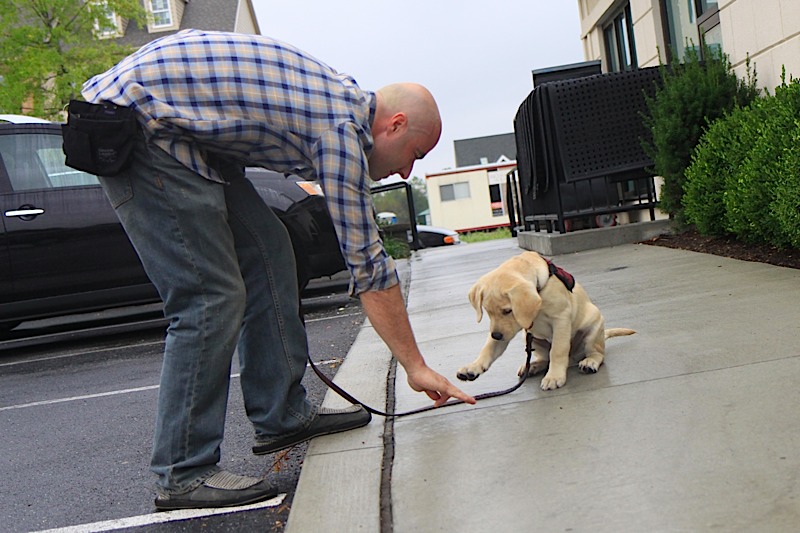
Rather than raising a puppy all the way through advanced assistance dog training, PAD Puppy Raisers provide a strong foundation during a puppy's earliest months. Through positive reinforcement, early socialization, confidence building, and basic manners, they help prepare puppies for the next stage of their journey with their future handler.
These early experiences play a critical role in shaping confident, resilient dogs that are ready to continue their assistance dog training alongside their future owner.
Anyone with the time, commitment, and willingness to learn may be eligible to become a Puppy Raiser. The primary trainer in the household must be 15 years or older, though other family members are welcome to take part in the training process.
Previous dog training experience is not required. We'll teach you everything you need to know while providing ongoing guidance, educational resources, and support throughout the program.
The most important requirement isn't previous dog experience—it's a willingness to learn and a desire to help change someone's life.
Complete our Puppy Raiser application through our website, and a member of our team will contact you regarding the next steps.
Applicants typically complete an interview, orientation, and home evaluation before being approved to receive a puppy.
Our goal is to ensure every volunteer feels confident, prepared, and supported before welcoming a puppy into their home.
Not at all.
Many of our most successful Puppy Raisers had never trained a dog before joining PAD.
We'll teach you everything you need to know through lessons, educational resources, and ongoing mentorship. You'll never be expected to figure things out alone.
Yes!
Many of our Puppy Raisers work full-time, attend school, or have busy family lives.
Because puppies are typically raised for a shorter period than in many traditional assistance dog programs, puppy raising is often more manageable than people expect. We'll help you determine whether your schedule is a good fit and provide guidance for balancing puppy raising with your daily life.
Absolutely.
Many Puppy Raisers have other dogs, cats, and household pets.
We'll discuss your current pets during the application process to ensure your home provides a safe, healthy environment for both your pets and your future puppy.
Most PAD Puppy Raisers care for a puppy for approximately three months.
During that time, you'll focus on building confidence, introducing the puppy to everyday life, teaching foundational skills, and preparing them for the next stage of their journey.
Once your puppy has completed this important foundation, they'll transition to their future owner, who will continue training through PAD's Owner Trainer Program with professional guidance and support.
You'll never be raising a puppy alone.
PAD provides professional guidance, educational resources, structured training plans, and ongoing support throughout your puppy raising experience. Raisers attend two classes each month in Ephrata, PA, and our trainers are available between classes to answer questions, troubleshoot challenges, and celebrate your puppy's progress along the way.
Our goal is to help both you and your puppy succeed.
PAD provides the puppy, veterinary care, approved equipment, and other program-related expenses as outlined in our Puppy Raiser policies.
Puppy Raisers provide what matters most—a safe home, time, consistency, and love during a puppy's earliest and most important developmental months.
Life happens, and we understand that.
PAD maintains a network of approved puppy sitters and volunteers who can care for your puppy if you're away or an unexpected situation arises.
We'll work with you to ensure your puppy continues receiving excellent care and consistency while you're gone.
Not every puppy will ultimately become an assistance dog—and that's okay.
As puppies mature, we continually evaluate their health, temperament, confidence, and overall suitability for assistance work. Some dogs discover they are better suited for other careers or life as a beloved companion.
At PAD, we believe finding the right career is more important than forcing the wrong one.
A dog's worth is never determined by whether it becomes an assistance dog. Every dog deserves a role where it can thrive.
Often, yes!
Because PAD's puppies transition directly to their future owner for continued training, Puppy Raisers frequently have the opportunity to meet the person who receives the puppy they helped start.
Many raisers enjoy watching their puppy continue to grow and develop while maintaining a connection with the team they helped create.
Volunteering
Ways to get involved, with or without hands-on dog work.
Phoenix Assistance Dogs is powered almost entirely by volunteers, and there are many ways to get involved—whether you enjoy working directly with dogs or prefer helping behind the scenes.
Volunteer opportunities may include puppy raising, puppy sitting, nursery care, administrative support, fundraising, events, photography, social media, facility projects, transportation, and many other roles.
Every volunteer plays an important part in helping us empower individuals with disabilities through assistance dogs.
PAD offers a wide variety of volunteer opportunities to match different interests, abilities, schedules, and experience levels.
Some volunteers work directly with puppies and dogs, while others help with office tasks, fundraising, events, marketing, photography, maintenance, transportation, grant writing, or special projects.
Whether you have a few hours each month or are looking for a long-term commitment, we'd love to help you find a role that's a great fit.
Not at all!
While many volunteers enjoy working with puppies and assistance dogs, many of our most valuable volunteers rarely handle dogs at all.
Behind every successful assistance dog team is a community of people helping with administration, fundraising, event planning, bookkeeping, marketing, maintenance, transportation, grant writing, photography, social media, and countless other tasks.
Whatever your talents may be, there's a good chance there's a place for you at PAD.
Yes!
Many volunteer opportunities are appropriate for families or younger volunteers when accompanied by a parent or guardian.
Because some positions involve handling dogs or other responsibilities, minimum age requirements may vary depending on the role. We'll be happy to help identify opportunities that are appropriate for your family's interests and abilities.
Not necessarily.
While some volunteer opportunities require you to be local, many others—including administrative work, fundraising, social media, marketing, graphic design, and other remote projects—can be completed from anywhere.
If you're passionate about our mission, we'd love to talk with you about how your skills can make a difference.
Donations & Support
How gifts, sponsorships, and partnerships support our mission.
There are many ways to support PAD and help empower individuals with disabilities through assistance dogs.
You can make a financial donation, become a monthly donor, sponsor a puppy or training team, donate supplies, volunteer your time, participate in fundraisers, or simply help spread awareness about our mission.
Every contribution—whether it's your time, talents, or financial support—helps us continue changing lives.
Absolutely.
Whether you choose to make a one-time gift or become a recurring monthly donor, your generosity directly supports our mission and helps provide training, educational resources, puppy care, equipment, and volunteer support.
Monthly giving provides dependable funding that allows us to plan for the future and expand our programs.
Donations may be sent online via PayPal to [email protected], or mailed to Phoenix Assistance Dogs of Central PA, 547 Wood View Drive, Lititz, PA 17543.
Yes!
Individuals, families, businesses, and organizations can help sponsor puppies, volunteer teams, or other areas of our program.
Sponsorship opportunities vary throughout the year and provide a meaningful way to directly support future assistance dog teams while making a lasting impact.
Yes.
PAD gratefully accepts many new and gently used dog-related items, training equipment, and other supplies that support our programs.
Because our needs change throughout the year, we recommend contacting us before donating items so we can let you know what is currently most helpful.
Absolutely!
We welcome partnerships with businesses, civic organizations, schools, clubs, and community groups that share our commitment to empowering individuals with disabilities.
Whether through sponsorships, fundraising events, employee volunteer opportunities, in-kind donations, or community collaborations, business partnerships help expand the impact of our mission while creating meaningful opportunities for community involvement.
Possibly.
PAD occasionally accepts donated puppies that meet our health, temperament, pedigree, and breeding standards. Because assistance dog work requires exceptional qualities, not every puppy will be an appropriate candidate for our programs.
If you're interested in donating a puppy, we'd be happy to discuss your dog's background and determine whether it may be a good fit for PAD.
As a volunteer-powered nonprofit organization, every donation directly supports Phoenix Assistance Dogs' mission of empowering individuals with disabilities through assistance dogs.
Donations help provide puppy care, veterinary services, training equipment, educational resources, volunteer support, and other essential program expenses that allow our teams to succeed.
Every dollar helps create greater independence, stronger partnerships, and brighter futures for the people and dogs we serve.
Still Have Questions?
Choosing an assistance dog program, becoming a volunteer, or deciding how to get involved is a big decision, and we understand you may have questions that aren't answered here.
Whether you're exploring our training programs, considering becoming a Puppy Raiser, interested in volunteering, or simply looking for guidance, we'd be happy to point you in the right direction.
Contact our team, and we'll help you find the program, volunteer opportunity, or resources that best fit your goals. We look forward to welcoming you to the PAD family.